
The problem
← All articlesDetect breaking changes before merge
Breaking changes in .NET code are often invisible at compile time. The compiler says green. The tests pass. Production fails the moment the first real request hits the changed code path. This article explains why that gap exists, what the most common breaking change patterns look like, and how GauntletCI closes the gap before a commit ever reaches the repository.
Why the compiler is not enough
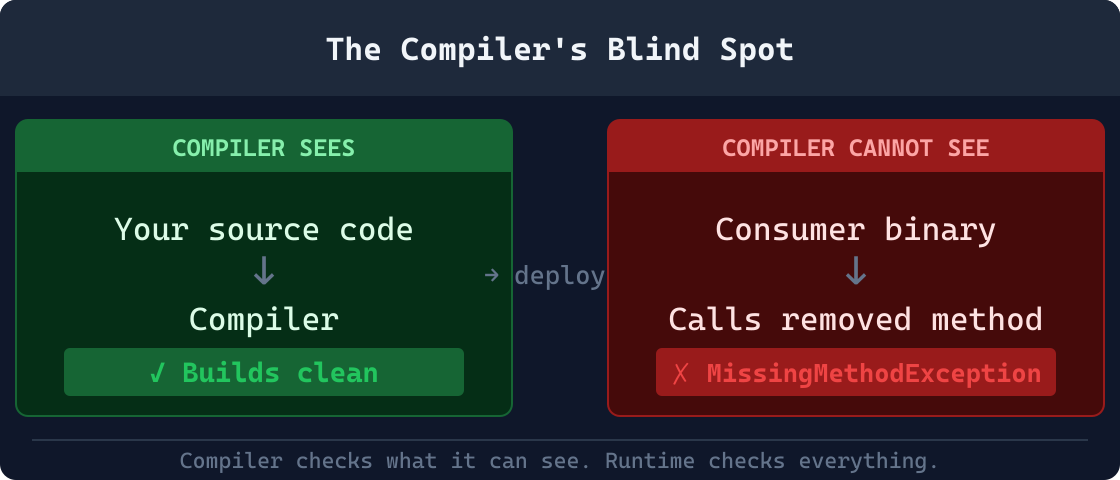
The .NET compiler catches type errors and missing references within a project or solution. It does not verify runtime contracts. A method signature change may compile successfully if all call sites within the repository are updated, but external consumers, serialized payloads in databases or message queues, and dynamically resolved services have no compile-time check at all.
The compiler operates on source. The runtime operates on binaries. When a library assembly is updated and deployed without recompiling every consumer, the compiler had no opportunity to raise an error for the consumer assemblies that still carry metadata pointing at the old method signature. The first runtime call to the changed or removed method produces a MissingMethodException or TypeLoadException that no amount of static analysis on the library alone could have predicted.
These are not rare edge cases. They are the normal state of any system with more than one service, any persistence layer, or any public API surface. The compiler success guarantee is narrow. The runtime failure surface is wide. This gap: the delta between what the compiler checks within the solution boundary and what the runtime encounters across all consumers: is The Compiler's Blind Spot.
Why semantic versioning does not prevent runtime breaking changes
Semantic versioning is a communication protocol, not an enforcement mechanism. A library author who increments the major version correctly has communicated that something breaking changed. The downstream consumer who has not yet updated their code still gets a runtime failure the moment they update the package reference without reading the changelog.
More importantly, semver requires the library author to know which changes are breaking in the first place. Research by Dig and Johnson found that 80 percent of the 147 breaking API changes they studied across open source Java projects were caused by refactoring: changes the author considered routine cleanup rather than intentional API evolution [1]. The study examined open-source Java projects; no large-scale .NET-specific dataset substantially contradicts the proportion, though the precise rate likely varies by ecosystem and project type. A developer who renames a method during a refactor sprint is unlikely to reach for the changelog before committing. Semver provides no signal until after the commit is merged and the package is published.
The intent gap matters here. The developer who renamed that method was not negligent: they were doing their job. The build passed, the tests passed, the linter was clean. The breaking change was an unintended side effect of a correct, intentional action. A pre-commit structural check is designed for exactly this case: flagging the unintended consequence before the developer has moved on.
The cost of discovering a breaking change at the consumeris higher than the cost of preventing it at the author. Hora et al. measured how downstream projects reacted when their library dependencies introduced breaking changes and found that many projects simply stopped updating the dependency, accumulating security and correctness debt rather than absorbing the migration cost [2]. The practical implication is that library authors who introduce unintentional breaking changes do not just cause immediate runtime failures; they cause long-term ecosystem fragmentation. Pre-commit detection converts this class of problem from an ecosystem-level event into a single-developer edit.
The multi-assembly problem in .NET: why internal compilation success does not mean external compatibility
In a .NET solution with multiple projects, the build system ensures every project within the solution compiles against the current source. When project A references project B, and a developer changes a public method in B, the build fails at project A immediately. This is the happy path. It is also the narrowest case.
The multi-assembly problem appears in three common real-world shapes:
- 1.Published NuGet packages. Once a library is published to NuGet, any consumer pinned to the previous version will not recompile when the author pushes a new patch. Consumers that accept floating version ranges and update the package will get a binary that no longer matches the signatures their code was compiled against. The result is a MissingMethodException or BadImageFormatException at the first call into the changed surface.
- 2.Plugin and extension architectures. Any host application that loads assemblies at runtime (MEF, Roslyn analyzers, ASP.NET Core middleware loaded via reflection) cannot recompile the plugins when the host API changes. The failure surface is entirely in the runtime layer, and it typically surfaces in production long after the host was updated.
- 3.Microservice contracts. When two services communicate over HTTP or a message bus, each service is compiled independently. Changing the shape of a shared data transfer object in one service does not cause a compile error in the other, even if both services live in the same repository. The failure appears at runtime when a payload of the old shape arrives at a deserializer expecting the new shape, often silently producing null-valued fields rather than a thrown exception.
Microsoft tracks hundreds of compatibility breaks introduced across .NET framework versions, many of which involve scenarios where the compiler produced no error [3]. The documentation distinguishes binary incompatible changes from source incompatible changes: two distinct failure modes that require different mitigation strategies and that a build server running inside a single solution boundary cannot detect.
Terminology: source-incompatible vs binary-incompatible
A source-incompatible change prevents existing consumer code from compiling against the new version: the compiler surfaces the error immediately at build time. A binary-incompatible changeallows consumer code to compile against the old assembly but fails at runtime when the updated binary is deployed. The consumer's build passes because it was compiled against the old API surface; the failure appears only when the updated library is loaded and a method or type that no longer exists is called. Most consumer-visible breaking changes in the wild are binary-incompatible.
Breaking changes in .NET OSS history: real examples from well-known libraries
The .NET ecosystem provides several well-documented examples of breaking changes that caused significant migration effort across the community. Each one follows the same pattern: correct compilation, runtime failure, delayed discovery.
Newtonsoft.Json to System.Text.Json. When Microsoft introduced System.Text.Json as the default serializer in ASP.NET Core 3.0, teams that migrated from Newtonsoft.Json encountered serialization contract breaks that were invisible at compile time. Newtonsoft serializes public fields by default; System.Text.Json does not. Newtonsoft performs case-insensitive property matching by default; System.Text.Json requires explicit configuration for the same behavior. Properties decorated with [JsonProperty] from Newtonsoft were silently ignored by the new serializer, causing wire format changes that surfaced only when stored payloads were read back or when downstream services that had not yet migrated received responses in the new format. None of these differences produced compile-time errors.
Entity Framework Core 6 to 7. EF Core 7 introduced breaking changes to how owned entity types are mapped to tables. Applications that relied on the previous behavior compiled without modification but produced different SQL at runtime. In some cases the queries returned wrong data rather than throwing an exception, which is the hardest failure mode to detect in automated testing. The EF Core team documented these changes in their migration guide, but developers who upgraded the package without reading the guide had no automated signal that behavior had changed.
AutoMapper major versions. AutoMapper removed its static API in version 9.0. Applications using the static API compiled against version 8.x would fail to compile against 9.x, but those that had already compiled and were running against 8.x would break only when the package version was updated and the host restarted. Teams running integration tests against the actual binary rather than recompiling from source would not catch the failure until deployment. The pattern repeats across the ecosystem because the toolchain provides no mechanism for flagging the risk at the point where the change is authored.
A breaking change the compiler cannot see
The following example represents the class of failures GauntletCI is designed to catch. The library compiles without warnings. The application compiles without warnings. The failure appears at runtime.
Suppose a shared library ships this public API in version 1.0:
MyLibrary.dll -- v1.0 (original)
public class OrderProcessor
{
    public void Process(Order order, bool sendNotification)
    {
        // process the order, optionally send notification
    }
}
A developer decides that notifications should always be sent and removes the parameter during a cleanup commit. The library is published as v1.1, a minor version bump, because the developer considers it a simplification rather than a breaking change:
MyLibrary.dll -- v1.1 (after the cleanup)
public class OrderProcessor
{
    // sendNotification removed -- notifications always sent now
    public void Process(Order order)
    {
        // process the order
    }
}
Any application compiled against v1.0 that calls processor.Process(order, true) will receive the following exception the first time that code path executes after the library is updated in production:
System.MissingMethodException: Method not found:
  'Void MyLibrary.OrderProcessor.Process(MyLibrary.Order, Boolean)'
GauntletCI rule GCI0004 detects this at diff time. When it sees that a public method signature was removed with no matching overload added, it produces a high-severity finding before the commit is created. The developer learns about the break while still in their editor, not after the library is deployed and a consumer integration test suite begins to fail.
The correct fix is straightforward once the risk is visible: keep the old overload, mark it [Obsolete], and delegate to the new signature. Consumers continue to compile and run. The old overload can be removed in the next major version after consumers have had time to migrate. This is the standard .NET deprecation path, and it is the action GCI0004 suggests in its finding output.
This is the core insight behind diff-based analysis: by analyzing exactly the lines that are about to change, GauntletCI identifies the structural risk at the only moment when it is still cheap to address it.
Breaking change patterns in .NET
The patterns below represent the structural changes that most commonly cause runtime failures across .NET applications. Each pattern can be introduced by a well-intentioned commit (a refactor, a cleanup, a schema update) that passes all automated tests because the test suite was written against the post-change codebase and does not exercise the consumer boundary at the binary level.
Public API surface
Removed public method
Callers that compile today fail at runtime after deploy if the method existed in a referenced assembly. GCI0004 flags this as high severity.
Changed method signature
Adding required parameters or changing parameter types breaks callers that used the old signature. Callers compiled against the old signature get MissingMethodException at runtime.
Removed interface member
Classes that implement the interface still compile. Classes in other assemblies that call the removed member fail at runtime with MissingMethodException.
Sealed class where previously unsealed
Callers that subclass the type at runtime (including mocking frameworks and dependency injection containers) fail with TypeLoadException.
Removed public property
Properties serialized to JSON, bound in XAML data bindings, or read via reflection by frameworks such as AutoMapper fail silently or throw at runtime.
Changed return type
Changing a return type is a binary breaking change even if both types share a common interface. Callers compiled against the old signature receive MissingMethodException.
Serialization contracts
Removed [JsonPropertyName] attribute
The property is no longer mapped from its wire name. Existing payloads silently deserialize to null or default, producing bugs that tests rarely cover.
Renamed property without attribute
The serialized name changes. Previously stored or transmitted JSON fails to deserialize, causing silent data loss on read.
Changed property type
JSON deserializers throw or silently coerce. Strongly typed consumers fail at runtime, and the failure may not surface until a specific payload shape is encountered.
Removed [JsonIgnore] attribute
A previously hidden property is now serialized. Downstream consumers may reject the extra field or surface internal data unintentionally.
Changed enum serialization mode
Switching between integer and string enum serialization breaks stored payloads and any consumer that relied on the previous wire format.
Dependency injection and service registration
Removed service registration
Code that resolves the service at runtime receives null or throws InvalidOperationException. GCI0038 flags removal of AddSingleton, AddScoped, and AddTransient calls.
Changed constructor signature
DI containers that resolve by convention fail to construct the type at runtime if required parameters are added or types change.
Changed service lifetime
Scoped services injected into singletons produce runtime errors or subtle state-sharing bugs that are hard to reproduce in unit tests.
Replaced concrete registration with interface
Code that resolves the concrete type directly (common in integration tests and some framework integrations) fails with an unresolved dependency error at runtime.
Database and storage
Removed EF Core entity property
Migrations not deployed before the application update cause runtime query failures when EF tries to map columns that no longer exist in the model.
Changed column type without migration
Data read from the old schema fails to map to the new type at runtime, producing either a conversion exception or silent data truncation.
Removed database index
Query plans that relied on the index degrade to full table scans. Throughput drops appear hours after deploy as query volumes increase. GCI0021 flags this pattern.
Renamed entity class or table
EF Core uses the class name as the default table name. Renaming without a [Table] attribute causes runtime failures against the existing database schema.
Thread safety and concurrency
async void method introduced
async void methods swallow exceptions silently. Unhandled exceptions escape the calling context and crash the process in ASP.NET Core. GCI0016 flags every non-event-handler async void.
Blocking async call (.Result or .Wait())
Calling .Result or .Wait() on a Task in an async context causes deadlocks in ASP.NET Core and Blazor applications. GCI0016 flags these patterns in added lines.
Static mutable field introduced
Static fields shared across requests in a web application produce race conditions that are nearly impossible to reproduce in unit tests.
lock(this) introduced
Locking on this exposes the lock object to external callers, creating potential for deadlocks from code outside the class.
Thread.Sleep in async context
Thread.Sleep blocks the thread pool thread, degrading throughput under load. In async code the correct call is await Task.Delay.
What GauntletCI checks: the rule set for breaking change detection
GauntletCI ships a library of deterministic rules that map directly to the breaking change categories above. Each rule is applied to the staged diff (the lines that are actually changing), so the analysis is scoped to the risk introduced by this specific commit, not the entire codebase. The following rules are most relevant to breaking change detection:
Breaking Change Risk
Detects removed public methods, properties, and type declarations. Fires when a public signature changes and no backward-compatible overload is provided. Rates every finding high severity.
Behavioral Change Detection
Identifies diffs where existing logic branches are modified rather than extended. Catches behavioral breaks not reflected in the type system, such as changed default values or inverted conditionals.
Data Schema Compatibility
Flags changes to database schema definitions, EF Core entity mappings, and migration files that are not paired with a matching migration deployment step.
Dependency Injection Safety
Detects removal of service registrations and changes to constructor signatures that would cause DI containers to fail at runtime during service resolution.
Concurrency and State Risk
Flags async void methods outside event handlers, blocking .Result and .Wait() calls in async contexts, static mutable fields, and lock(this) patterns that introduce thread safety breaks.
Naming Contract Alignment
Detects renames of public members, serialization properties, and API route paths that change the external contract without a corresponding migration or deprecation strategy.
Code review alone cannot reliably catch these patterns at the pace modern teams merge. Boehm and Basili documented that the cost to fix a defect rises by roughly an order of magnitude for each phase it survives past the point of introduction [4]. The specific multipliers vary by project context, but the directional finding has been replicated across multiple software engineering cost models. A breaking change caught in the diff before the commit costs a single edit. The same breaking change caught in production costs an incident, a rollback, and an investigation. Why code review misses bugs explores this cost curve in more detail.
The right time to detect is before the commit
Finding a breaking change in post-deploy monitoring means a rollback, an incident, and a post-mortem. Finding it in code review means a comment and a revision. Finding it before the commit is created means a fix before anyone else is involved.
Static analysis scoped to the staged diff rather than the entire codebase delivers feedback at the only moment when the cost of a fix is minimal: before the commit exists. The analysis surface is bounded by the size of the commit, so the check completes in milliseconds regardless of codebase size. GauntletCI implements this model with deterministic structural rules: every public API removal, every serialization contract break, and every unsafe concurrency pattern in the diff produces a finding on every run.
Determinism is what separates structural rules from probabilistic analysis. A tool that produces inconsistent results trains developers to dismiss findings as noise. A structural rule that fires every time a public method is removed without a replacement overload carries no false-negative rate for that pattern. Developers quickly learn which finding types require mandatory action and which allow deliberate acknowledgment, and that distinction preserves the signal value of every finding the tool produces.
Analyzed in milliseconds
GauntletCI reads the staged diff, not the entire codebase. Analysis completes in under a second for typical commits, adding no perceptible friction to the development workflow.
No CI pipeline required
Runs as a pre-commit hook. The developer sees the risk before the commit is created, not after the PR is opened, the pipeline runs, and a reviewer has already context-switched away.
Zero false negatives for structural rules
Rules like GCI0004 and GCI0038 match structural patterns in the diff text. If a public signature is removed, the rule fires. There is no threshold that can be misconfigured to suppress it.
Works in monorepos and multi-project solutions
Because the analysis is diff-scoped rather than solution-scoped, GauntletCI works equally well in single-project repositories and large monorepos with dozens of projects sharing public API surfaces.
Post-publish compatibility tools such as Microsoft.DotNet.ApiCompat and binary compatibility analyzers verify API surface after a library is built or released. They are valuable for library maintainers managing a public NuGet surface across versions. GauntletCI is designed for an earlier moment: before the commit is created, before CI runs, and before any consumer is affected: the only point where the cost of the fix is zero and the developer still has full context to address it.
References
- [1]Dig, D. and Johnson, R. "How Do APIs Evolve? A Story of Refactoring." Journal of Software Maintenance and Evolution, 2006. Studied 147 breaking API changes across open source Java projects and found 80 percent were caused by refactoring. https://dl.acm.org/doi/10.1002/smr.328
- [2]Hora, A., et al. "How Do Developers React When Their Libraries Break?" ICSME 2015. https://ieeexplore.ieee.org/document/7332473
- [3]Microsoft .NET Breaking Changes documentation. https://learn.microsoft.com/en-us/dotnet/core/compatibility/breaking-changes
- [4]Boehm, B. and Basili, V.R. "Software Defect Reduction Top 10 List." IEEE Computer, 34(1), 2001. Documents the order-of-magnitude cost increase for defects that survive each successive development phase.
Real-world examples from .NET OSS
These case studies show GauntletCI catching the exact patterns described above in real pull requests to widely-used .NET libraries.
Breaking API Removal in EF Core
GCI0004 catches public method removal without [Obsolete] - breaks all third-party EF Core database providers.
Assignment in Getter - Newtonsoft.Json
GCI0004 and GCI0036 catch a property getter that mutates state, breaking the side-effect-free contract.
Eric Cogen -- Founder, GauntletCI
Twenty years in .NET production. Most of those years, the bugs that hurt me were not the ones tests caught. They were the assumptions I did not know I was making: a removed guard clause, a renamed method that still did the old thing, a catch {} that turned a page into a silent dashboard lie. GauntletCI is the checklist I wish I had run before every commit. It runs the rules I learned the hard way, so you do not have to.